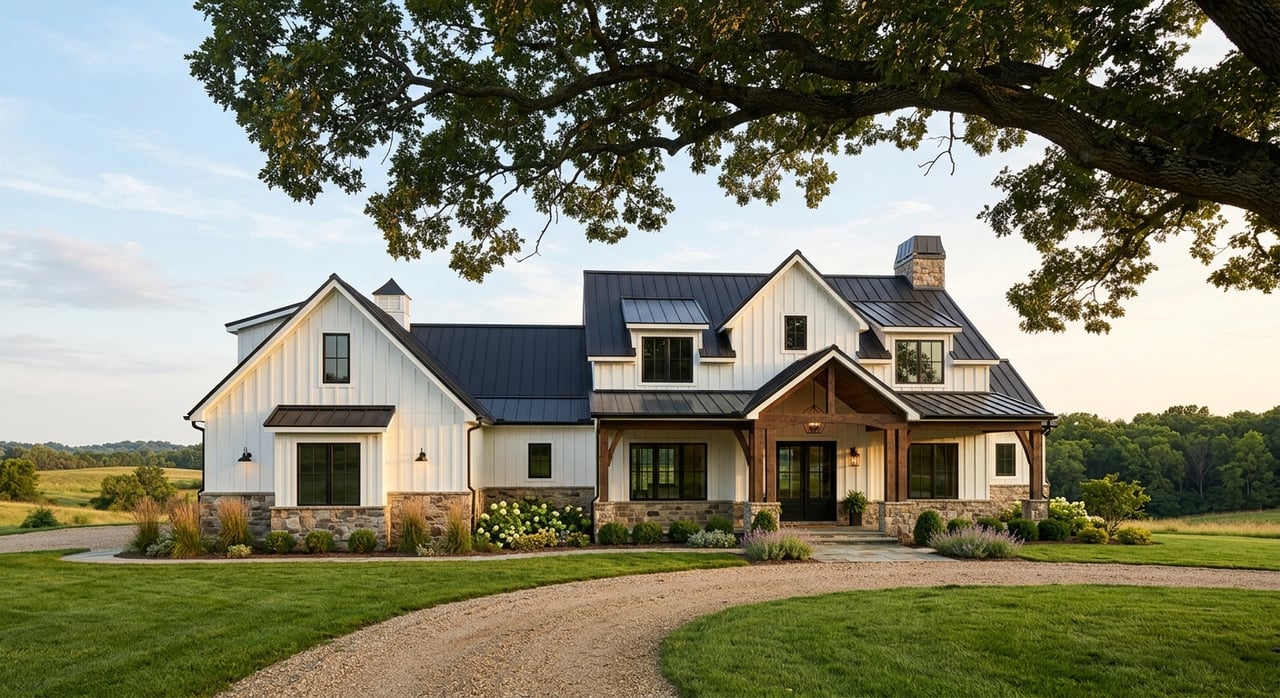
Trying to decide whether Jackson County or Cass County is the better fit for rural living? You are not alone. Many buyers around Kansas City want more space, more privacy, and a property that supports the way they actually want to live, but the right county depends on what matters most to you. If you are weighing commute time, acreage, zoning, taxes, and overall feel, this guide will help you compare the tradeoffs with more confidence. Let’s dive in.
Jackson County vs. Cass County
If you are comparing these two counties for rural living, the biggest difference is density. According to the U.S. Census QuickFacts data for Jackson County, Missouri, Jackson County’s 2024 population estimate was 727,362 with 1,186.4 people per square mile, while Cass County’s population was 113,873 with 154.8 people per square mile.
That gap helps explain how each area tends to feel on the ground. Jackson County often functions more like a suburban-rural transition zone, especially in its eastern rural areas. Cass County, by comparison, tends to offer a more consistently low-density, owner-occupied rural setting.
Homeownership and home values also help tell the story. The same Census data shows a 59.1% owner-occupied housing rate in Jackson County compared with 75.6% in Cass County, while median owner-occupied home values were $230,500 in Jackson County and $292,400 in Cass County. For many buyers, that means Cass County may align more closely with a long-term acreage lifestyle, while Jackson County can offer a middle ground between country space and metro access.
Land and parcel sizes
If acreage is high on your list, this may be the most important part of your search. The two counties support different types of rural inventory, and that difference affects what you are likely to find.
Jackson County’s master plan describes its Rural Development Tier as an area intended for rural living and open space. Parcels in that tier are generally at least five acres, and lower service levels are more common, including wells and on-site wastewater systems.
Cass County’s zoning guide is more specific about parcel thresholds. Agricultural parcels are generally more than 20 acres, rural-residential parcels can be as small as 3 acres, and suburban residential parcels can go down to 1 acre. That makes Cass County especially appealing if you want clearer separation between agricultural land, rural-residential living, and more suburban-style options.
Farm footprint and rural inventory
Countywide farm data also reinforces the difference in rural character. The USDA 2022 Census of Agriculture county profile shows Jackson County had 588 farms covering 80,664 acres, with an average farm size of 137 acres.
Cass County had 1,314 farms covering 301,581 acres, with an average farm size of 230 acres. That does not mean every Cass County property is a large farm, but it does support the idea that Cass County generally has more true farm and acreage inventory. In Jackson County, you are more likely to find smaller lifestyle tracts and transitional acreage near the metro.
Commute and convenience
If you want rural living without feeling far removed from Kansas City area services, commute time matters. The same Census QuickFacts data shows Jackson County’s mean travel time to work was 23.4 minutes in 2020 through 2024, compared with 28.0 minutes in Cass County.
That roughly 4.6-minute difference may not sound huge at first, but over time it can shape your daily routine. If you need easier access to jobs, shopping, and other metro services, Jackson County often has the edge. If you are willing to drive a bit more in exchange for larger tracts and a more rural setting, Cass County may be the better match.
Property taxes and carrying costs
Many buyers assume county name alone tells them what taxes will look like, but that is only part of the picture. In Missouri, the State Tax Commission notes statewide assessment ratios of 19% for residential property, 12% for agricultural property, and 32% for commercial property.
Jackson County explains that real estate tax is based on taxable value and the levy rate for the property’s location, with reassessment every odd-numbered year. The county also notes that school, city, fire, and other districts make up much of the total tax bill, which means the county itself is only one piece of the equation.
Cass County’s tax entities and rates page makes the same point. Tax rates are set by local taxing jurisdictions, and the final bill depends on the property’s exact location and the entities that levy against it. In practical terms, you should compare the full tax stack for a specific property, not just whether it sits in Jackson or Cass County.
Why levy rates matter
School and district levies can make a noticeable difference in annual carrying costs. Jackson County’s 2025 agency levy comparison lists examples such as Blue Springs R-IV at 5.1685, Grain Valley R-V at 4.7396, Oak Grove R-VI at 4.7731, Lone Jack C-6 at 4.8785, and Fort Osage R-1 at 6.2500.
That same levy comparison lists Cass County examples such as Pleasant Hill R-3 at 4.5971, Archie R-5 at 4.5095, Sherwood R-8 at 4.6549, Raymore-Peculiar R-2 at 5.0302, and Midway R-1 at 5.5292. Those differences can affect your yearly budget before city, fire, library, road, and special-district levies are even added.
If you are comparing two rural homes, it is smart to ask for the actual tax bill and levy breakdown for each one. That gives you a more accurate view of ownership costs than county averages alone.
Schools and parcel verification
If school district boundaries are part of your decision, verify them at the parcel level before you write an offer. District assignment is not a countywide shortcut. It depends on the exact property.
For rural buyers in Jackson County, the levy comparison identifies districts such as Blue Springs R-IV, Grain Valley R-V, Oak Grove R-VI, Lone Jack C-6, and Fort Osage R-1. In Cass County, listed districts include Pleasant Hill R-3, Archie R-5, Sherwood R-8, Raymore-Peculiar R-2, and Midway R-1.
A few district examples offer useful context. The Blue Springs School District states that it serves 15,373 students and that the Class of 2025 included 1,213 graduates. Grain Valley Schools reports a top-10% APR score and says more than 92% of high school students graduated in four years, while Pleasant Hill R-III has publicly posted APR materials including a 2023 supporting report showing 80.2% total APR and a 100.0% result on the six-year graduation-rate measure.
Which county fits your goals?
For many buyers, the answer comes down to lifestyle. Jackson County often makes sense if you want a rural property that still feels connected to the metro. You may find it easier to balance open space with a shorter commute and access to Kansas City area services.
Cass County often makes more sense if your top priorities are larger acreage, more clearly agricultural land-use patterns, and a more consistently rural setting. If you picture true farm ground, a larger buffer from suburban growth, or a property with more room to spread out, Cass County usually has the stronger case.
A simple way to decide
If you are still torn, use this quick framework:
- Choose Jackson County if you value shorter average commute times, easier metro access, and rural living in a transition zone.
- Choose Cass County if you value more acreage, a larger farm footprint, and a setting that generally feels more rural.
- Compare parcel-specific details before deciding, especially zoning, well and septic setup, school district assignment, and the full levy structure.
The best county for you is not always the one with the biggest tract or the shortest drive. It is the one that supports how you want to live day to day.
If you are weighing acreage, lifestyle property, or a move from suburban living into a more rural setting, working with a team that understands both counties can make the process much clearer. Dana Benjamin helps buyers and sellers navigate land, lifestyle acreage, and rural homes across the Kansas City area with the kind of hands-on guidance that helps you compare the details that really matter.
FAQs
What is the main difference between Jackson County and Cass County for rural living?
- Jackson County generally offers a more suburban-rural transition feel with shorter average commute times, while Cass County usually offers more acreage and a more consistently rural setting.
How much larger are farms in Cass County compared with Jackson County?
- Based on the USDA 2022 Census of Agriculture county profiles, Cass County had more farms, more farmland acres, and a larger average farm size than Jackson County.
Are property taxes lower in Cass County than Jackson County?
- Not always. Your total tax bill depends on the property’s exact location and the combined levies from school, city, fire, library, road, and other districts.
Should you verify school district boundaries for rural properties in Jackson or Cass County?
- Yes. School district assignment is parcel-specific, so you should confirm the exact district for any property before making an offer.
Is Jackson County better for commuters who want rural property near Kansas City?
- For many buyers, yes. Census data shows a shorter mean travel time to work in Jackson County than in Cass County, which can make daily access to metro services easier.